Want To Begin A Daily Sketchbook? Here's A Good Place To Start

The first in a series about daily sketching!
Committing to a creative sketchbook project can be daunting for many reasons. Personally, my sketchbook project-related trepidation has to do with my relationship to time and worries about "wasting" it, my uncertainty about not knowing how things will turn out or whether they'll be "good," and my compulsion to be "productive" in a way that is measurable as a working artist. There are a lot of words in quotations here and I'm sure this topic could make an entire blog post, but I won't get into psychoanalyzing the artist's mind today! I've always felt that my creative practice is deeply connected to my self-discovery and self-actualization. I'm sure you have your own thoughts about this, so do share them in the comments or get them out of your head and into your journal.
Today, rather that focusing on the reasons why it's hard to get started, I thought I would offer a few tips or gentle guidelines to help you get over that hump and actually begin. Answer the following questions for yourself, and I think you'll find that clearly outlining what you do and don't want to do can be exactly the first steps you need to reduce barriers holding you back and start your project.
Why do I want to start a sketch project?
If you're here reading this, I'm guessing you don't need any convincing that a daily sketch project is a good idea. However, digging a little deeper and understanding your personal reasons for beginning this project can help you feel anchored in the work. If you don't choose a why, then you may feel scattered and more likely to quit (speaking as a chronic creative scatterbrain.) Maybe you became inspired by another artist's practice: write down what inspires you and choose a few of those things as your initial reasons to get started. For example, maybe you want to develop a colour palette that feels unique to you, or perhaps you'd like to loosen up and make art that is more expressive without needing to feel self-conscious about it. I recommend keeping your reasons pretty simple to start.
My "why" for daily sketching: I want to keep my brain on the thread of my creative practice, even when I'm not actively working on a professional project. I also want to invite more wonder, play, and exploration into my creative work, and a daily sketchbook allows me to practice that and become more comfortable with the uncertainty of taking creative risks.
Hot tip: Write yourself a few baseline rules on a sticky note to put on the front of your sketchbook as a way to stay focused on your reasons. These can and probably will change, so feel free to write a new sticky whenever they do. Mine would say, "A pretty picture is not the goal" to remind me that my sketchbook time is about the time spent exploring and what I learn from it, not the results.

What kind of commitment is realistic for me and how will I stay accountable?
Be realistic about your time but also remember what your priorities are by returning to your "why." This can help you decide how to structure your time and be realistic about your accountability going forward. Would it be helpful to do this work at the same time every day to make it less likely for you to forget? Could setting a timer help you to wrap up your work in a reasonable amount of time? Will you be able to stick to the project on weekends, or is that an unrealistic expectation? Will you forget about the new routine you set for yourself come Monday? (this is me!) Do you need to set a reminder on your phone or put it in your calendar? Do you need a sketch partner or some friends to keep you accountable? Do you need a creative workstation set up and ready to go or a private space available so there are fewer barriers to getting started? Set yourself up for success and give yourself the structure you may need. This is a chance to be practical and honest with yourself about what you need and not a good time for lofty goals.
My daily sketch commitment is flexible but committed. I'd like to sketch every day, but sometimes I don't and I'm cool with that. If I miss a day, I pick up where I left off the next day. Currently, summer days can get busy, and it isn't always realistic for me to make time for sketching, especially because I have a personal hang-up about making creative work in the vicinity of observers (I'll work on that)! I began my project with an early morning sketch each day, but this summer that has evolved to any time of day that I can fit it in or whenever I just feel like sitting down and messing about a bit. This summer, I am not working on any ongoing painting commitments, so I have a lot of flexibility in my schedule. My Instagram has become my accountability tool. I have been sharing each sketch on my IG stories as I make them and then also sharing a post to recap all the sketches of the previous week each Sunday. The engagement I get from the online creative community makes it pretty motivating for me to keep going.
Hot tip: Finding an accountability partner can be scary. Maybe you're a bit hung up on not wanting to share this work with anyone, and that's understandable. Acknowledge why that is, and forge onward! Here are a few ideas that could work for you: Find another person who wants to do a similar project so you can share the work with each other, either in person or through photos. If you are on Instagram, try creating a "close friends" list and share your sketches in stories that only they can see. If you don't want feedback, then let them know that specifically, "don't let me know what you think!" Instead, ask your accountability partner(s) to acknowledge the work you have done and ask you one question about it. If you really don't want to show anyone your work, then simply ask someone to check in with you each day. Perhaps have partner ask, "When do you plan to sketch today?" or "Did you make time to sketch? What did you make? What did you learn?" There is a bit of vulnerability involved here and that is the point. You don't learn or change anything about your creative practice without taking a few risks. Trust that creative resiliency is something you can develop over time with practice.

How can I set myself up to get started?
I recommend that you keep things simple to start. You can always change your set up, buy more supplies, and expand your space later on. When you begin with a simple set up, you spend less time getting ready to work and can get started sooner. Speaking from personal experience, "getting ready" can be a sneaky way to procrastinate. It's sometimes easier and more exciting to go shopping for fun things or set up a great workspace than it is to actually sit down and begin (because, scary). Keeping it simple can give you permission to just rip off that bandaid and get started. You will develop your set-up further as you go, so try not to spend too much time thinking about it before you begin.
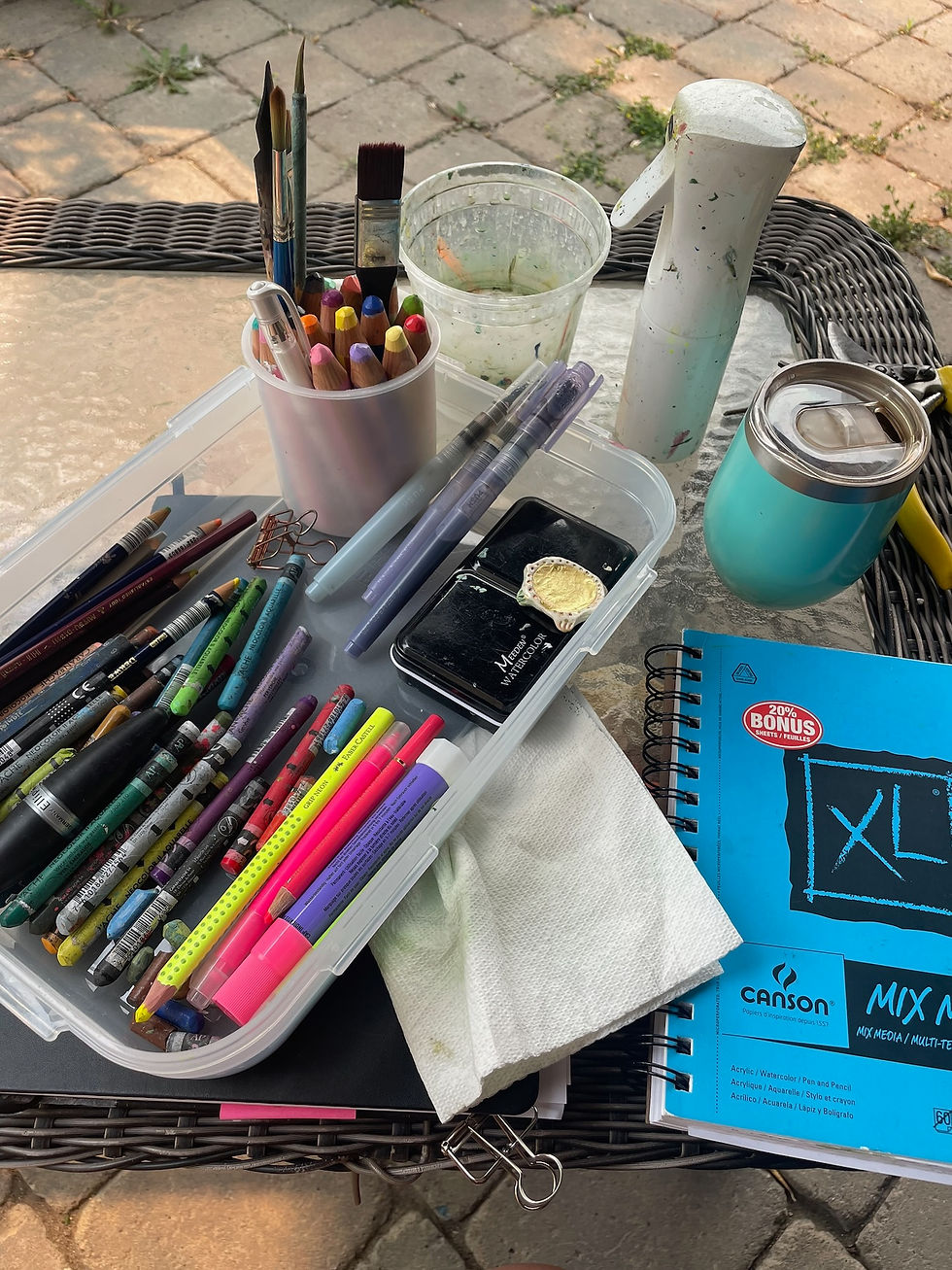
That being said, sometimes it can be helpful to have a space ready for you to work so that you don't have to set up each day. I am lucky to have a dedicated studio space but there is a way to keep your space very simple and flexible if needed. A little storage box or bin can be your "studio." In it, you can store your various supplies and sketchbook so that they are accessible and available to use at the kitchen table, counter, desk, couch...wherever, whenever. If you have more supplies than can fit in your little storage bin, be selective about what you choose and put the rest away until you need an injection of novelty to liven things up.
I recommend beginning with one or two sketchbooks and a modest selection of materials that excite you. You don't need to spend a lot of money on supplies but if you'd like a handful of new things to spark a little creative energy, by all means, get them! The point is, try not to get hung up on spending a bunch of money to copy someone else's creative set-up or in an attempt to make your set up perfect. You don't need to have the exact brand of pencil crayons or colour palette layout or type of sketchbook as your favourite artist. You also don't need full colour sets of media or every thickness of micron pen "in case you need them." What you need is to collect a few things that call to you, that you can use to fulfill your reason for this project, and that can help you find out for yourself what you like and don't like. Add to and subtract from your setup as you carry on.
My initial setup for this project was very simple. Although I currently use a lot of various media, including both drawing supplies and many different paints, I initially started with just a few unfinished sketchbooks that I happened to have laying around and a small container of various markers. In the past I have dipped into my kid's discarded school stuff and the junk drawer to collect supplies. Pencils, pens, hi-lighters, kid's markers and crayons - these things can certainly be enough to start! Does that old white-out pen (that your kid just HAD to have in order to be successful in grade 3) spark curiosity? Add it to your pencil case! Again, go back to your "why" and let that guide your choices here. Keeping your reason for the project in mind, ask yourself, "what is the minimum that I need to get started?" and start there. It's a good opportunity to use what you have. Keeping things simple can reduce barriers to beginning. Trust that you will learn more about what you need as you continue with the project.
Hot tips for supplies:
If you plan on using paint or wet media, choose paper that is a heavier weight for your sketchbook so that you have less buckling to deal with.
Having at least two sketchbooks of different sizes with different kinds of paper can help you have options and also allow you to set pages aside to dry and keep working on other things.
Clips or elastics can help you keep your sketchbook pages open while you work. An old newspaper or table cloth can protect the surface of your workstation.
Scrap paper can be helpful to test colours or slip between finished pages as a barrier to prevent media from transferring or pages from sticking together.
Rags or paper towel, a spray bottle, a palette and a water container are necessary for painters. A pencil sharpener and a place for the shavings is necessary for drawing media.
When buying supplies, instead of investing in sets of colour, choose a handful of individual colours that you love. Try to get a variety of tones including very lights, midtones and very darks. Give yourself a bit of variety for line quality, texture and opacity. It can be easy to collect a lot of show-stopper colours but also remember that neutrals can be just as wonderful.
Again, go back to that personal "why" and allow it to guide your choices. If you need to, set a budget for both your time and money when creating your set up. Remember this does not need to be perfect. Imperfection is an invitation to possibility. Trust that your supplies and space will evolve as your creative practice does.
I hope that answering these questions for yourself has been useful. If you are beginning your sketchbook project, know that many others are also in the beginning stages, too, and it is normal to feel unsure and inexperienced. With action comes discovery! As you work, your uncertainties will ease or, at the very least, they will evolve and change. I was once a beginner. I often still feel like a beginner in many ways and I still have absolutely no idea how things are going to turn out on the page. I recommend getting comfortable with that feeling and even allow it to excite you.
Share your thoughts! I'd love to know if you are planning to start a sketchbook project and how it is going. You can see my daily sketches in my Instagram stories and in my weekly recap posts on Sundays. You can read about when I first began this daily project of mine in this blog post. You can also see an album of sketches I have made this year here.


Comments